When systems fail, your business won't
Business continuity, disaster recovery, and impact-tolerance frameworks aligned to DORA, RBI, and global guidance.
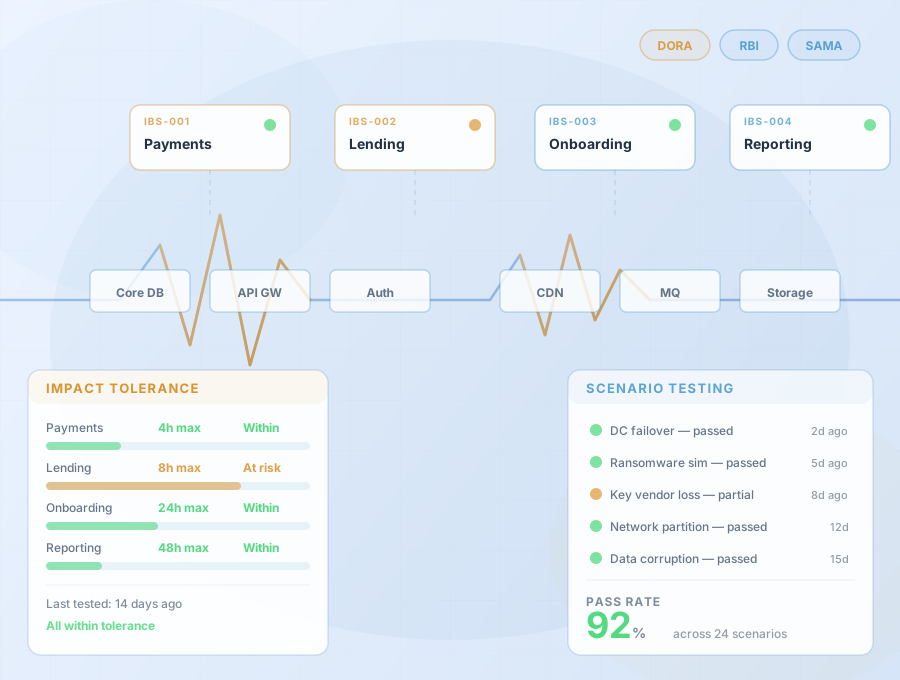
Regulators no longer accept "we have a BCP." They want demonstrated impact tolerance, tested scenarios, and mapped dependencies between business services, IT, and assets. Most organizations have plans on paper that have never been exercised.
How we approach it
- STEP 01
Map important business services
- STEP 02
Set impact tolerances
- STEP 03
Test against severe scenarios
- STEP 04
Remediate & repeat
The full scope
- Important Business Service identification
- Business-IT-Asset dependency mapping
- Impact tolerance setting and approval
- Severe-but-plausible scenario testing
- BCP / DR plan refresh and exercising
- DORA, RBI, and SAMA alignment
What you get
- IBS Catalogue
- Dependency Map
- Impact Tolerance Statement
- Tested Scenario Library
- Board-ready Resilience Report
Regulated entities in BFSI, healthcare, and critical infrastructure, plus any organization where downtime has material impact.
Frequently asked questions
How long does an initial program take?
A baseline IBS catalogue and dependency map typically takes 6–8 weeks. Platform accelerates this.
Do you facilitate the exercises?
Yes. We design, run, and report on tabletop and technical recovery exercises.
Related services
Most clients combine two or three of these. Here's what pairs well with this engagement.
AI Security
Govern AI use, secure GenAI deployments, and align to ISO 42001 & NIST AI RMF.
ExploreCloud Security
Hardening across AWS, Azure, and GCP: CSPM, IAM, Zero Trust.
ExploreVendor Risk (TPRM)
Continuous third-party assurance, AI Trust Center, automated questionnaires.
ExploreIS GRC
ISO 27001, SOC 2, NIST, PCI DSS, GDPR: readiness through certification.
ExploreDPDPA Compliance
End-to-end readiness for the Digital Personal Data Protection Act 2023 and DPDP Rules 2025.
ExploreConsent Management
Tamper-evident consent artefacts, multilingual notices, one-click withdrawal. Built for the DPDP Act.
ExploreReady to strengthen your security posture?
Book a free 30-minute consultation. No slides, just a working conversation about your gaps and roadmap.